For someone who continually teaches the importance of recognizing the signals of climate change and an unsustainable food system – and leveraging them for action – July provided an alarming array of examples that highlight the need for urgent, deep, collaborative global action to reduce emissions and accelerate progress toward the Sustainable Development Goals (SDGs).
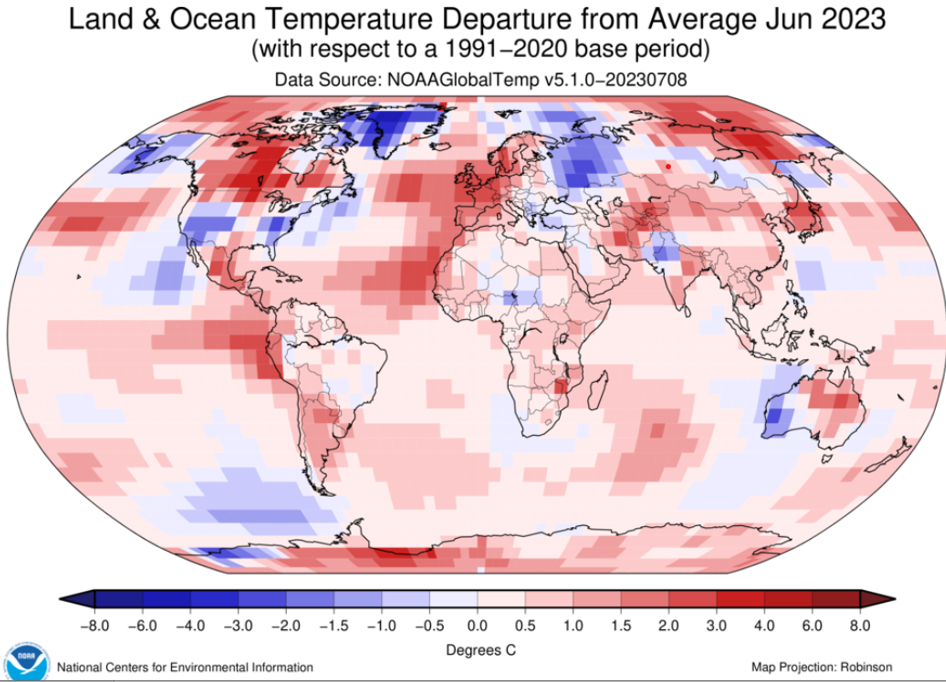
This on the heels of stunning warning signs throughout the month of June, which the National Oceanic and Atmospheric Association (NOAA) noted was the hottest June on record – with average global surface temperature coming in 1.89 degrees Fahrenheit (1.05 degrees Celsius) above average.
Also in June, NOAA indicated that for the third consecutive month the global ocean surface temperature hit a record high, sea ice coverage was at a record low for any June on record, and tropical storm activity in June exceeded 1991-2020 averages.
One month later, smoke from the Canadian wildfires remained problematic, while the northeastern U.S. (particularly Vermont and New York) experienced devastating rain and flooding.
But the overriding climate story in July involved scalding temperatures and their effects around the globe. For example:
Writing in The New York Times, Plumer and Shao reported that the three days from July 3rd through July 5th were likely the hottest in Earth’s modern history, ominously noting that “the sharp jump in temperatures has unsettled even those scientists who have been tracking climate change.”
In the U.S. southwest, the city of Phoenix set a record for the most consecutive days (31) beyond 110 degrees Fahrenheit, while in China, Sanbao township experienced that country’s temperature record of 126 degrees Fahrenheit (52.2 degrees Celsius).
In Europe, The Washington Post reported that temperatures exceeded 104 degrees Fahrenheit (40 degrees Celsius) in parts of Spain, France, Italy, Greece, and Bosnia, while Sicily reached 115 degrees Fahrenheit.
Fires raged in Greece and many other countries across Europe, while in Iran, the heat index reached 152 degrees Fahrenheit (66.7 Celsius) at Persian Gulf International Airport.
Further, ocean temperatures off the coast of Florida reached 100 degrees Fahrenheit.
Given these and other notable high temperature events, it’s not surprising that the World Meteorological Organization (WMO) and Europe’s Copernicus Climate Change Service found that the first three weeks of July were the hottest three-week period on record.
Referencing July’s record heat, UN Secretary General Guterres poignantly stated that “the era of global warming has ended, and the era of global boiling has arrived.”
Alarm bells are sounding. Yet despite all of these highly visible warnings, and the many others leading up to them in recent years, I remain struck by the lack of concerted global progress on emissions-driven climate change and the broader SDGs.
In fact, the UN Sustainable Development Solutions Network (SDSN) noted that at the halfway point to the deadline for the SDGs, “all of the SDGs are seriously off track” and that “not a single SDG is currently projected to be met by 2030, with the poorest countries struggling the most.”
I marveled at the many powerful signals of emissions-induced warming throughout July, events which directly affect the viability of critical ecosystems and especially threaten our ability to successfully feed the global population.
It is clear that the Earth is literally screaming at us in protest, demanding change such that we operate within planetary boundaries.
The sheer number and power of the signals we are getting as a result of our unsustainable systems and behaviors should be all-motivating, especially given that no country is immune from the impacts of climate change nor the tightly linked, multiple externalities of the food system – such as soil erosion, deforestation, biodiversity loss, ocean acidification, and plastics pollution.
And yet the disconnect between the urgency level and the needed collaboration and action among nations to accelerate meaningful progress toward climate change and the SDGs (i.e. the action gap) remains clear – and truly nonsensical.
Addressing the Disconnect
At this critical juncture – halfway to the SDG deadline and inundated by signals of the need to limit global warming and transform the global food system – it is essential for each of us to ask ourselves: How can I help break this disconnect? How can I influence others to drive bigger, faster change in my circles?
To start, it’s worth reflecting on some of the barriers to action we see among individuals.
Some simply don’t understand the threat of climate change and food system dysfunction, despite the many signals noted above. Others don’t believe that human activity is driving climate change and, spoiled by historical abundance, do not accept the threat to future food supplies.
Some individuals simply don’t care and are unwilling to consider changes to ensure a viable planet for future generations. Some feel that climate and SDG challenges are simply too big, too daunting, for them to address, while others are simply too absorbed with other concerns and lack the ability to focus on another sustainability challenge.
Some are complacent, banking on the fact that technological developments will save us in time, while others are frozen to inaction by the fear of change. And some choose to ignore the market opportunities in emissions reduction and sustainable food systems, opposing change due to entrenched interests.
These and other blockers are common at the consumer level and bleed up to business and government levels as well – and all must be addressed.
Two Points of Inspiration
For those reacting to the many current signals and seeking to become changemakers, I offer two inspirational reference points this month.
First, go back and review Paul Polman’s remarks from July of 2021 at the UN Food Systems Pre-Summit in Rome. In a brilliant 5-minute talk, Polman challenged all of us to take action to transform our food systems and advance progress toward the SDGs, noting that if an individual were to come from outer space and look at the way we handle our food systems – putting our lives at risk – he/she would think we are “nuts.”
He added that our current food system treats the environment as if it is an infinite resource, with the result that we are seeing the “rapid degradation” of people and planet. He’s right, as July’s many temperature records indicate.
And he pointed to the inextricable link between the food system and climate change, noting that “it is impossible to achieve the Paris Agreement on climate, or the Sustainable Development Goals, if we don’t drastically change the food system.” Right again.
Polman also addressed the disconnect theme, stating that of all the options to advance sustainable development, transforming the food system probably has the highest return from an ecological, social, and financial perspective, and that “with our own existence being put at risk, with enormously attractive economics, it’s just mindboggling to me that we’re not moving faster.”
Highlighting that value proposition, he noted that a relatively modest investment of $300-$400 billion could be transformed into a $4-5 trillion economic force, while saving trillions of dollars in damages to people and planet.
Further, Polman cited the need to go beyond circular economy packages to regenerative solutions, and he called for countries to submit national food system pathways, to be reviewed every two years, whereby progress would be assessed and updated targets could be set with an action and accountability focus.
Significantly, and related to the disconnect, he asked what is missing – citing human willpower and courage, and questioned whether we really care enough to drive the needed change.
He added, “This is a once in a generation opportunity…the race is on for Nature-positive, net-zero, resilient food systems that once and for all allow us to stay healthy, be abundant and feed the world, and most importantly, be equitable. If we miss this opportunity, we miss mankind.”
Polman’s call out – What are we missing? – remains even more appropriate two years later, as evidenced by July’s many signals of environmental distress.
Second, I recommend the recent Policy Brief (Food Systems and Planetary Goals: Two Inseparable Policy Agendas) from the Global Panel on Agriculture and Food Systems for Nutrition.
The Brief highlights the linkage between food systems, climate change and the SDGs, noting that “food systems have no viable future without delivering on climate change and planetary goals – but conversely, these cannot be delivered without addressing unsustainable food systems that continue to damage the health of the planet and people.”
And since we all participate in and rely on food systems daily, we all have a role to play in ensuring their long term viability.
Moving Forward – Finding the Right Framing
In my view, this theme of “breaking the climate/SDG disconnect” needs continued attention, and it will be a key component of my upcoming courses as I continue to educate future changemakers as part of my #123Pledge.
And I continue to seek out the most inspirational framing to further that educational effort.
For example, some often use the term “Moonshots” when speaking of the needed food system transformation. I’ve referenced that theme in the past and suggested the importance of Earthshots. Others have called for a Marshall Plan approach. And in a recent piece in the Financial Times, Camilla Cavendish called for a wartime footing to address the climate crisis – making the fight against climate change “a joint endeavour against a common enemy” and suggesting that by galvanizing public and political will via such an approach human ingenuity can prevail.
Cavendish makes a compelling argument. Such framing involves viewing the challenge in life or death terms, acting with unified purpose and with unparalleled urgency at unprecedented scale.
And at core, such framing involves capturing public and political will out of necessity to address a global threat.
What suggestions do you have for inspirational framing to spur action to address the climate/SDG disconnect?
Please feel free to share them with me. Let’s find the right framing to address the climate/SDG disconnect, galvanizing urgent, collaborative action across sectors and nations.
For as UNSG Guterres noted, we’ve moved from warming to boiling, and the only surprise with recent temperature records is the speed with which we got to this point.
Without urgent change to cut emissions and transform the food system, we should not be surprised that we will quickly experience worse.
 food for thoughtful action