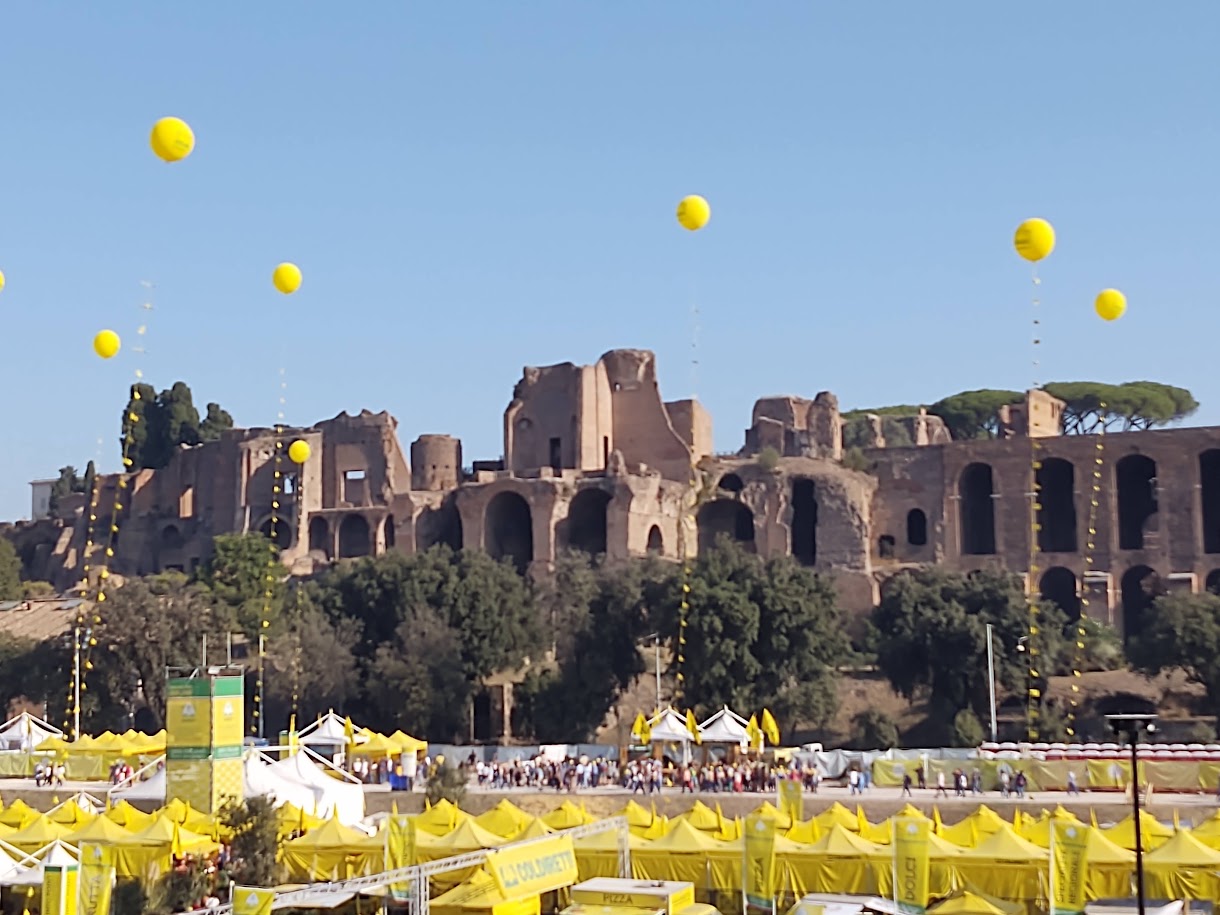
A few weeks ago I was fortunate to be in Italy working with key food system partners at the Future Food Institute and others beginning with a celebration of Italian Food heritage and excellence at Villaggio Coldiretti in Rome before moving south for a deep dive into the Mediterranean Diet.
It’s an incredible time in the food system space, and the timing for this food system-focused trip was perfect, coming shortly after the International Day of Food Loss and Waste (IDAFLW) and setting the stage for even more global attention on food systems with World Food Day 2023 and the COP28 sessions.
And as always, there is no better place to reconnect deeply with the value of food than Italy.
I spent three incredible days at the Villaggio Coldiretti (Coldiretti Village) event at the Circus Maximus in Rome, surrounded by stunning history at the foot of UN FAO headquarters just prior to World Food Day – a highly appropriate time and place to celebrate the value of food.
As per its website, the Coldiretti, now with 1.5 million members, is “the main organization of agricultural entrepreneurs” at the national and European Union level and was created “to promote the biodiversity and sustainability of Italian agriculture and the quality of Made In Italy agri-food.” The Village represents “the meeting between the world of agriculture and society, the place of proxmity, food, meeting, dialogue and community.”
Having spent three full days at the Village, along with a reported two million others, I can attest to the fact that it is succeeding in its mission. There was a positive intensity to the event which reminded me of my time at Expo Milano in 2015, the global gathering that kicked off so much focus on food systems and the connection to the SDGs.
Food (or agri-food, if you like) was not only central at the Villaggio Coldiretti, it was endless.
The Colderitti Village was (is) a celebration of the excellence of Italian food items, and the culture underlying it. I spent hours over the course of the event viewing, discussing, and tasting countless items from all regions of Italy – jams, honey, cheeses, olive oil, bread, fruits, vegetables, nuts, and so much more. More importantly, I had fantastic conversations with many passionate small producers about their farms and focus – and somehow the excitement about their products always transcended the languge barrier.
Among all of the producers at the Coldierett event there was an intensity about communicating the quality of their food. Their pride, passion, and commitment to excellence came through strongly, as did their clear desire to educate others on the special characteristics of their particular food items, and I was inspired by each of them.
Similarly, I was incredibly inspired, as always, by the work of Sara Roversi and the Future Food Institute team who curated an incredible series of tours and sessions to showcase the deep history underlying the Italian food system, the culture of passion and respect for food, the focus on preserving biodiversity, the importance of gathering around and sharing food (conviviality), and the power of the Mediterranean Diet to enable humanity to live healthy lives within planetary boundaries.
This trip was marked by incredible food tastings (really, food experiences) in settings of unparalleled beauty, elevated further by the ability to meet and learn from numerous small farmers, larger producers and culinarians. Regardless of size and product, the commitment to quality, human health, and planetary health was consistent and deep.
Reconnecting, Regenerating, and Reimagining
The entire experience points to one overriding theme that never fails to impress me while in Italy – a culture that properly values food and the larger food system that supplies what we consume. And throughout the week three key themes resonated deeply with me – the importance of reconnecting with our food, regenerating people and planet through our food system, and reimagining our food system by blending traditions with innovation. All are vital themes for transforming our global food system and driving faster progress toward the Sustainable Development Goals.
The deep connection that Italian farmers and producers have with the soil/land and biodiversity came through repeatedly.
For example, a speaker from Del Colle, a producer of cereals and legumes, expressed that “land is sacrifice, and commitment.” Del Colle is working to drive awarenss around the importance of nutrition and eating properly; their website notes that “eating well is ecological, it is well-being, it is culture.” The company notes that 1) legumes make the soil fertile, 2) legumes and cereals are the basis of the human food pyramid and of the Mediterranean Diet, and 3) legumes and cereals are part of the gastronomic traditions of Italy – and therefore consuming them equates to preserving the Italian cultural heritage.
I found additional messaging on their site to be refreshing and important:
Choosing a sustainable diet means preferring foods with low environmental impact, respectful of biodiversity and ecosystems. Being aware of what we put on our plate is an ecological act , a necessary choice for our psycho-physical well-being but also a cultural act that preserves the historical memory that also passes through our local gastronomic traditions.
A speaker from Le Stagioni d’Italia (a producer of pasta, rice, legumes and cereals) stressed the importance of controlling all aspects of the production process – from seed to shelf – to ensure optimal quality, and the concept of traceability (tracciabilita) was further emphasized by many others.
Further on the connection theme, a speaker from the Mediterranean Agronomic Institute of Bari (CIHEAM Bari) cited the importance of constantly being in the field and learning more about the soils and the farmers. He cited the importance of gathering around good food, while also referring to much food in the U.S. as “synthetic” – thus breaking the connection between food and people.
He added that it is vital to exchange knowledge for a better food system, citing the Italian food heritage as “a one of a kind experience” that must be shared around the world.
Cullural tradition, high quality, authenticity, preservation of biodiversity and regenerative agriculture were addiitonal key themes covered in many sessions (in fact, on a very positive note, I’ve never heard the word biodiversity mentioned so often, and so naturally, over the course of a week).
For example, on the importance of cultural heritage, a winemaker noted that “the history of Italian wine is a history of excellence,” with a video adding that Italian wine is much more than wine, but is culture, tradition, landscape, cooperation, and biodiversity. Her commitment to tradition and quality was clear.
A cheese producer (Gran Padano) noted that “we produce a cheese that goes back 900 years, and we try not to modify it.” His passion for the product was evident as he invited us all to visit their production facility to “feel the magic of the place.”
There were continual references to high quality production. One small olive oil producer noted that “quality always gives something back,” while another added “just preserve the characteristics of your olives to get the best results from them.”
A small grappa producer went deeper, speaking with incredible passion about the farm culture and tradition behind his product and noting that “the differentiator of a product is the truth.”
Circular and regenerative themes were continuously emphasized.
On waste reduction, a chef went around the event gathering leftoviers (onion, bread, eggs, and cheese) from which she created an amazing dish in a cooking demonstration with the addition of tomato sauce, casually noting while cooking that “our philosophy is not wasting.”
A producer of olive oil discussed how the pumice from production is used for fuel, stating that “nothing that comes out of the production process is thrown away.”
And as noted earlier, there were constant references to preserving biodiversity.
A small maker of jams and products from “forgotten fruits” (which require little in the way of fertilizer) noted that “our secret ingredient is biodiversity,” adding that “we hope that forgotten fruits will survive and become future fruits.” One producer noted that “you can taste the biodiversity on your plates,” while another stated “we are the guardians of biodiversity.”
In terms of reimagining the food system, there was much discussion of blending technology with tradition. A speaker from fruit producer Unifrutti Group, for example, described how the company is making use of technology and data metrics obtained via satellite to operate more sustainability, including monitoring the health of plants and trees and employing precision farming techniques to optimize water usage and reduce water pollution. He added that precision farming helps them cope with climate change.
All of these talks were incredibly inspirational, revealing authenitic concern for people and planet, and it was not hard to imagine the benefit of normalizing such themes among food producers everywhere.
Discovering the Lands of the Mediterranean Diet
Building on the foundational themes from the Villaggio Coldiretti event, we moved south with the Future Food Institute with a focus on history, culture, conviviality, and education in exploring the benefits of the Mediterranean Diet.
It was a natural progression, a blend of history and innovation with a constant theme on the value of high-quality, sustainable Italian food (the value of food) and the connection to human and planetary health.
And along the way one couldn’t help noticing that food is literally grown everywhere in Italy – orchards and fields of grain abound alongside railways, and gardens are pressed up against commercial buildings and in between apartment buildings. Food is a constant part of the landscape.
We began at Paestum, an incredibly beautiful UNESCO site, gaining insight into the depth of Italian history and culture. From there we journeyed to a beautiful 9th century castle (Castello di Rocca Cilento) for a fantastic five-course meal with discussion of local ingredients and food traditions with the chef.
And later at the Future Food Institute’s Paideia campus we discussed reimagining food as the catalyst that fosters fertility, prosperity, and longevity of life on Earth.
Local fisherman Vittorio Rambaldo discussed how his family fishes in sustainable fashion for the oily fish that are a key component of the Mediterranean Diet.
Pollica’s Mayor Stefano Pisani discussed the many ongoing initiatives with the Future Food Institute related to sustainable food production and how they are blending innovations with traditions to build the future, noting the importance of helping the younger generation address the future of food.
Pisani emphasized conviviality, noting that the most important thing to do in Pollica is to share food with people. He stated that “If you eat well, you can stay well, and you can save the planet,” adding that the Cilento region has one of the highest rates of centenarians in the world.
We also reviewed the health dimension of the Mediterranean Diet and the potential for integrative approaches to treatments for cancer. Dr. Luigi Montano of EcoFood Fertility discussed research on how the Mediterranean Diet detoxifies the body and the importance of producing food that restores cells specific to fertility.
We began the following day with a visit to the museum of the Mediterranean Diet, which is designed to show the food ecosystem of the Cilento region and the biodiversity of the sea.
Sara Roversi explained that the Mediterranean Diet is more than food, it is a lifestyle – one which is based on three pillars: culture, health, and sustainability. She added that the Mediterranean Diet is a mindset of well-being, reflecting a balance between humans and Nature, and that Cilento holds the highest biodiversity of any region in Europe.
We then turned our focus to regenerative farming at Tenuta Chirico with innovative culinarian Siliva Chirico, tasting her fantastic cheeses and gelato before touring her farm and learning of their regenerative approach to food production.
Silvia discussed how their farm is fully circular and regenerative, producing food from the animals each day along with energy from the waste products. She guided us through a tasting of many of her innovative cheeses and gelatos (noting that she took advantage of the early Covid downtime to further research traditional ingredients and create new flavors) and explained that she has been able to protect “the real” in her products. In addition, she educates youth on the importance of traditional ingredients and food preservation.
Silvia stated that her family has always been interested in being a full circle farm, noting the need to “start from the soil and return to the soil.” Echoing the theme of control from other vendors earlier in the week, she explained how they control the seed, grow the food, and process the milk into multiple products. All waste from food production and the cows goes to the biodigester to power farm operations.
We then traveled to La Petrosa in Ceraso, a leading regenerative farm led by Edmondo Soffritto. La Petrosa is a multi-functional farm and restaurant, producing crops, olive oil, cheese and bread.
Like others we met throughout the week, Edmondo is bringing innovation and technology to traditional methods. He is one of the most active members of the regenerative farming movement in Italy with an intense focus on the health of the soil, which he described as an “entire approach” to the farm and the environment. Significantly, his focus is not on producing more, but on creating the highest quality of the soil by maximizing organic matter content and carbon capture ability.
Edmondo noted that everything on the farm revolves around circularity and the elimination of waste, explaining that “waste to value is my assignment.”
Together with other farmers he has created a food market to feed local people, noting that “the challenge is to feed people here versus Milan.” He added that the market also serves as an educational mission, showing people what is behind their food (another recurring and inspiring theme of the week).
It was very clear that everything about La Petrosa is revolves around giving back to people and to the planet, especially through the soil. Edmondo strongly believes that regenerative farming needs to be a bottom up movement, explaining that industrial farming accounts for 30% of global greenhouse gas emissions, while regenerative farming is net positive, and urging us to consider the impact if all food producers were net positive!
Finally, we ended our trip with a tour of a fig producer (Santomiele), learning about the many varietals of figs in Italy and the traditional process of harvesting and curing them with just sun, wind, water, lemon and salt.
Takeaways for food system change
The Villaggio Coldiretti event and the deep exploration of the Mediterranean Diet with the Future Food Institute provided numerous takeaways for the creation of a more sustainable food system revolving around reconnecting with our food and the land and farmers that produce it, emphasizing regenerative processes to maintain biodiversity and ensure the health of people and planet, and reimagining how to leverage traditional production methods and values with innovative technologies to create a more sustainable global food system.
And all of them center around a central topic of this blog – the need to properly value our food and the farmers and resources that are involved in bringing it to us.
The passion of all of the Italian food producers for the quality of their food and their cultural heritage was truly inspirational, as was their commitment to the soil, traceability, responsible production and biodiversity, and authentic concern for contributing to both human health and planetary health.
Especially notable was their desire to educate others on the many benefits of regenerative practices and the Mediterranean Diet.
We are at the halfway point to the Sustainable Development Goals, yet we are falling well short of providing sufficient nutrition for billions and operating well outside of planetary boundaries in the process.
By 2050, we’ll be faced with the added challenge of feeding 2 billion more citizens.
Clearly we need to very quickly transition to a sustainable, equitable, regenerative food system – one which simultaneously improves human health and planetary health.
As we seek to reconnect with the value of food, advance regenerative agricultural practices, and reimagine how to link traditional (sustainable) production methods with new innovations, we can draw inspiration and ideas from many producers in Italy.
 food for thoughtful action