Among many powerful images of the effects of climate change on our planet in 2024, some of the most impactful to me were those depicting the damage from the extreme flooding which occurred in Valencia in late October – a region which received the equivalent of one year’s worth of rain in just eight hours.
For several days while in Spain I watched the nightly coverage of the anger and social upheaval related to the devastation, including angry crowds yelling “murderers” and throwing mud at King Felipe and Queen Letizia as noted by the Financial Times.
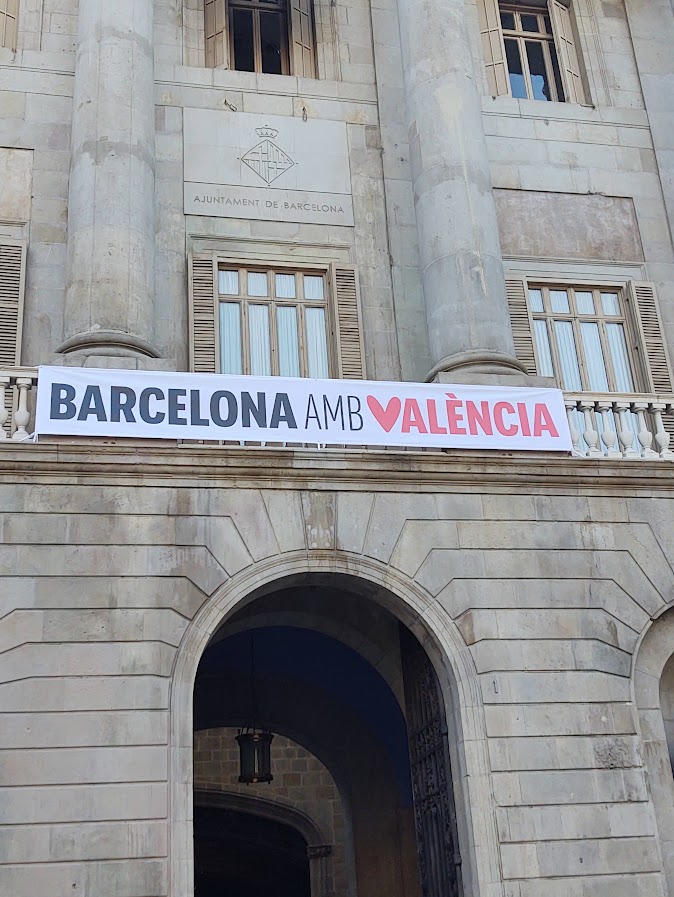
Later in the week, I observed a prominent banner hung on a building overlooking a square in Barcelona with the message Barcelona loves Valenica – a touching symbol of support for their fellow Spaniards suffering in the flood zone.
The flooding in Valencia reminded me of the physical destruction from so many other climate-related disasters in recent years. Coming just days before I attended the EFOOD24 conference in Barcelona, the timing of the event was poignant for me. Here I was, in Spain to attend a food design conference with a focus on addressing the many critical challenges of the food system – including emissions-driven warming – while the surrounding region was grappling with the impact of the extreme rainfall which left more than 200 dead.
I was reminded of a similar experience in 2023, when I traveled to Bologna to teach a class on innovation for sustainability related to the food-water-energy nexus, arriving just after the Emilia Romagna region had been devastated by flooding following an extreme storm event in which the equivalent of six months of rain fell in just 36 hours on drought-stricken soils.
Also striking to me was a conversation with a colleague at the conference from Brazil, who explained that she had just experienced the major flooding event in Rio Grande do Sol earlier this year – in which three months’ worth of rain fell over a two-week period in part due to the effects of climate change – only to see similar devastation upon her arrival in Spain.
Sadly, such events are becoming the new normal. The New York Times reported that the flooding in Valencia “is a foretaste of the extreme storms that the region can expect to see more of as humans continue heating up the planet.”
Food: Big and Invisible
Food, of course, plays a major role in driving the warming conditions leading to these destructive storms around the world, as the food system accounts for 34% of total greenhouse gas emissions. And in many areas, food production leads to land degradation and deforestation that amplifies the destructive impact of extreme weather events, while also depleting water supplies, reducing biodiversity, and accelerating plastic pollution.
In October, the Financial Times reported on the effects of global warming in South America, highlighting that historic drought conditions have led to energy blackouts and water rationing while forest fires continue to spread throughout the Amazon region.
Also in October, The New York Times linked global food security to the water crisis, reporting that the world’s food supply is concentrated in a small number of countries, and many of those countries are threatened by water shortages.
And despite the massive amount of food production around the world, we’re still falling well short of providing sufficient nutritious food for all global citizens while losing and wasting about 40% of food annually.
These are all signals of a food system in need of transformational change – one which becomes more sustainable, regenerative, and equitable, and which accounts for the true cost of food.
The food system is big (in fact, colossal) with huge impact on planetary health and human health, but in many ways we’re not seeing its costly impacts. Its size and constancy make it oddly invisible. We subconsciously expect the benefits that it provides without dwelling on the negatives.
Similarly, the visible impacts of climate change are big (again, colossal) – we hear about them constantly, and we see the images of drought, fires, and floods (like those in Emilia Romagna, Valencia, and Rio Grande do Sol), but at the same time it is as if we aren’t truly seeing them – because we aren’t moving aggressively enough to change the drivers.
Moving to Sitopia
Carolyn Steel (architect, author, and creator of the “sitopia” concept) discussed the invisible nature of the food system in her November keynote address at EFOOD24 in Barcelona.
Steel reminded conference participants that everything in our world is shaped by food, and yet we somehow don’t really “see” and understand that critical association which in turn shapes so much of our activity. She noted that the reason we don’t truly see the impact of the food system in our daily lives is precisely because it is so big – it is everywhere at once – and therefore we become numb to it, taking it for granted despite its criticality for our existence.
She further described the urban paradox – the fact that much of our food today is grown far away from where we live – where we can’t see it. That physical distance factor diminishes our understanding of all of the resources (and complexity) involved in growing our food, while our highly efficient transportation system, which continually brings abundant food to our nearby markets, reinforces that separation.
By contrast, Steel pointed to early cities, such as 16th century London – where food flowed through the city at all times and literally shaped its layout. Food markets contained local, seasonal food products and were points of sociability for city residents. Livestock were driven from the nearby countryside through the city to urban markets. Over time, however, advances in technology and transportation allowed urban dwellers to rely upon food items grown far away from city centers, thus breaking the deep connection to food sources previously held by individuals and creating the perception of great varieties of low-priced food being “automatic” to many in the developed world today.
Further, Steel noted that today we are “killing ourselves and the planet in the quest for cheap food.” She correctly challenged our expectation of abundant low cost food, noting that “there is no such thing” as cheap food – it is merely a concept that the food industry has created by externalizing all of the environmental and social costs of global food production, such as food waste, greenhouse gas emissions, biodiversity loss, and obesity.
On that score she offered a provocative perspective – the idea that “food is life” – stressing that we cannot consider food to be cheap because we have to kill something to get it.
In Steel’s view, fixing the food system comes down to two questions: how do we eat, and how do we live?
Accordingly, she offered her concept of sitopia – or “food place,” – suggesting that we use food as a lens to ask all of the key questions that Utopians ask. For example, noting that humans get the most pleasure from eating with and sharing food with others – she asked why we don’t do more of it, specifically asking why Americans eat 1 in 5 meals in cars. Further, she pointed out that properly valuing food is a “no-brainer,” and therefore questioned why we fail to do so.
Last, Steel called for repurposing the economy around food and internalizing the true cost of food. She noted that utopia is an idyllic place, but is no place, while sitopia – food place – is one that we can achieve if we use food as a lens to ask all of the questions that Utopians ask.
Visibility: Observations and Signals
In the wake of the Valencia disaster, Steel’s comments on the enormity of the global food system – coupled with its paradoxical invisible nature – were quite timely. Food is such a constant in our lives that it is largely invisible, and we don’t notice the many externalities of our system of food production, distribution, and consumption (or in the case of uncomfortable topics such as hunger, we may simply choose to ignore them).
But we need to challenge ourselves to look deeper – to truly appreciate the criticality of our food resources and to understand and address the environmental and social externalities in order to create a more sustainable and equitable food system.
And Barcelona is the perfect place for such exploration.
Barcelona’s streets and squares literally teem with outdoor cafes and restaurants; the sound of clinking plates is constant as one explores the city. Food is everywhere, and it is the celebratory anchor for the countless social gatherings that provide immense vibrancy well into the night.
As Carolyn Steel noted at EFOOD24, humans are social creatures with the desire to connect with one another and live well, and we feel best when we are sharing food. Similarly, chef Pablo Britton stated that “eating together is one of the most powerful points of (human) connection.” The proliferation of outdoor tables in Barcelona is a clear indicator of our desire to experience conviviality through the sharing of food with companions, as well as the connective power of food.
After a night of celebration, however, we can easily observe some of the externalities of our food system if we choose to see them.
Winding through the streets and alleyways, we step around large piles of trash (including some portion of wasted food) from many eating establishments awaiting pick-up and disposal to landfill.
We see homeless individuals sadly left out of the celebrations over food that so many others were fortunate to experience, revealing the challenges of equity and food security.
We see health externalities stemming from overconsumption and/or lack of access to sufficient nutritious food.
And we see extensive plastic waste related to food deliveries. I observed one case in which the plastic shrink wrapping from one single pallet in a delivery to a Starbucks location completely filled the nearby public trash bin.
Multiple vehicles suddenly emerge to haul away trash and clean the streets throughout the night, and very early in the morning the food replenishment process begins – with streams of trucks from multiple food producers and distributors (their engines never turned off) restocking all of the city’s cafes, restaurants, and retailers – giving insight into the vast emissions impact of our modern food system.
The food replenishment process is highly efficient, its automated nature giving credence to the invisible nature of the system – food is continually moving all around us in such seamless fashion that it alleviates the need to think deeply about accessing it. We simply expect great varieties of food to be available at all times.
And with the immense clean-up and replenishment process complete early the next morning, the city’s many food establishments and supporting organizations are ready to repeat this vibrant, yet costly, food-driven cycle again and again.
Embracing Visibility, Leading Change
To be sure, the positives of today’s food system are many. The fact that so many global citizens enjoy access to abundant food supplies and can focus on positive contributions to society without worry about where their next meal is coming from is indeed major cause for celebration. In this way, the efficiency leading to the invisible nature of the food system is good. Similarly, the joy and social connection gained from the sharing of food in dynamic food cultures such as Barcelona is extremely positive for human well-being.
But at the same time, the environmental and social costs associated with today’s food system are extensive.
While the food system is in some ways so big as to be invisible to us, the signals of these externalities are clearly visible – we just need to look and really see them, taking the time to understand their scope, scale, and impact as well as what we can do about them.
And when we start to observe these signals and reflect deeply on their drivers – we quickly realize the centrality and criticality of food to people (both physiologically and socially), the enormous environmental and social impacts of the food system, and the urgent need to lead change efforts for a regenerative and equitable food system capable of providing sufficient nutritious food for all global citizens within planetary boundaries.
Further, we quickly realize the importance of properly valuing our food, and the absurdity that 40% of global food production is lost or wasted annually.
As we enter 2025, the world is well off track on the Sustainable Development Goals, with just five years remaining until 2030.
We continue to see the consequences of emissions-driven warming in the form of heat waves, droughts, fires, intense storms, and flooding (as in the case of Valencia).
In November, the World Meteorological Organization (WMO) reported that 2024 was on track to be the hottest year on record.
Yesterday, in his New Year 2025 message, UN Secretary General Antonio Guterres stated that “The top ten hottest years on record have happened in the last 10 years, including 2024,” adding “This is climate breakdown – in real time.”
And in the U.S., we are likely at the beginning of a multi-year period in which environmental regulations and societal norms regarding compassion for others will be put to the test.
Amid all of these negatives, food provides each of us with an opportunity to create positive change for people and planet.
As Carolyn Steel reminds us, if we understand how food shapes our lives, we can make it a really powerful tool to shape the world better.
We are all participants in the global food system, and food is a nexus issue, so if we re-orient our energy around food and the creation of a more sustainable food system, we can simultaneously drive environmental and social gains at the heart of multiple SDG Targets.
For example, by focusing on reducing food loss and waste, we can:
- Reduce harmful emissions and all of the resource-related externalities involved in the production and distribution of food
- Accelerate upcyling opportunities to convert byproducts into new value-added products
- Capture and redirect nutritious food resources to feed those in need.
- Reduce packaging waste
- Free up resources to address the root causes of social problems, such as poverty
- Raise expectations of food organizations to demonstrate responsible behavior and reduce externalities throughout all of their production and distribution processes
- Educate and raise expectations of policymakers to enact responsible legislation consistent with creating a long-term sustainable food system
- Shift focus from overproduction and excessive waste to responsible production and consumption
Driving such change starts with getting past the invisible nature of the food system, seeing and understanding the scope of its many externalities, and committing to taking action and influencing others in our circles.
As we begin a new year, it’s important to note that we can be disruptors – driving positive environmental and social change through our values toward food and our fellow citizens.
Carolyn Steel provides an appropriate framing in her 2011 TED talk (Sitopia: how we can think through food) for how we might think about acting to create a more sustainable, equitable food system. I find it highly appropriate at this particular point in time, and I’ll offer it here as a point of inspiration for overcoming the invisibility paradox and driving positive food system change in 2025:
If you ask the question, What kind of society do you want? – that starts to tell you what kind of food system you want.
This is about the entire world.
It’s about the global North and the global South.
It’s about what we are, how we eat, but also about how we respect each other, the kinds of lives you want to create.
And our food values are a beautiful collaborative tool available to us now that we can share to create a better world.
 food for thoughtful action