The end of each year always brings reflection on where we are along with a go-forward look as to how we can expand our impact, especially for those of us working to advance food system transformation and progress on the Sustainable Development Goals.
It is a time when many of us are asked whether we are hopeful or optimistic about the future, and a time when we naturally seek inspiration to continue evolving our work for the better.
For those focused on the key sustainability challenges of climate change, food security, and biodiversity loss, 2025 was a difficult year on multiple fronts that were covered frequently on this blog, including record temperatures, drought and devastating fires, intentional cuts in food aid to the most vulnerable, the breaching of multiple planetary boundaries, and the global climate conference in Belem (COP30) which failed to deliver commitments at the required level. We continue to see an immensely concerning disconnect between the magnitude of our climate and sustainability challenges and our actions to address them, resulting in existential risks for billions of global citizens.
While at COP30, I engaged in a conversation with a colleague on the subject of optimism for a sustainable future which inspired me to dig a bit deeper beyond my 2021 post on the subject.
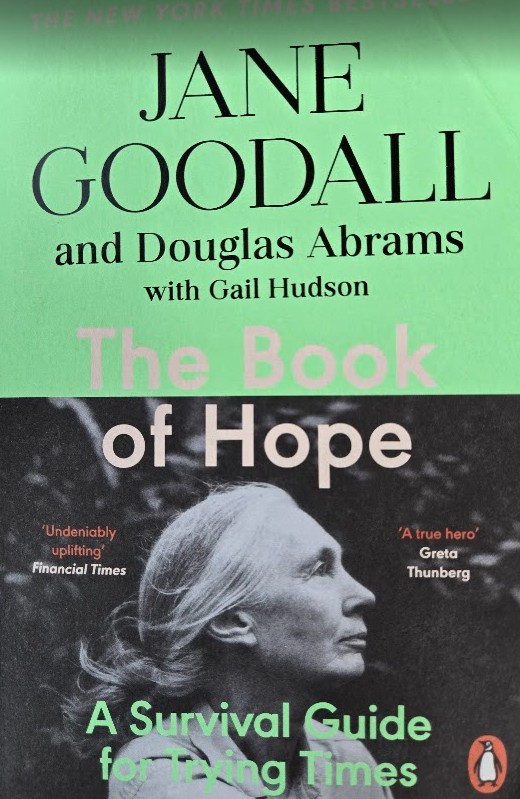
And with the passing of the iconic Jane Goodall in October, I felt compelled to revisit her 2021 work with Douglas Abrams and Gail Hudson, The Book of Hope – A Survival Guide for Trying Times.
In it, Goodall draws on her decades of compassion-driven conservation leadership to provide a candid assessment of the magnitude of the climate and biodiversity challenges facing the world along with several guiding points on how to address them.
For those who are in need of a boost of sustainability-focused inspiration, now is the perfect time to review the work of Jane Goodall.
In The Book of Hope, Goodall reminds us that “One of the most important determinants of hope in one’s life is seeing one’s agency, one’s ability to be effective,” and that the positive outcomes that we achieve in turn create more hope for change.
In other words, hope drives action, which drives increased hope and additional action.
The book provides an excellent framing for all individuals seeking to drive positive social and environmental change; several key points are covered in detail below.
Hope, Will and Collective Action
First, on the broad theme of whether she felt hopeful for the future of humanity, Goodall cited her belief that the world still has a window of time in which we can begin to heal the harm that we have inflicted on the planet – but she warned that the window is closing.
She referred to hope as a “survival trait” and gave the first of many urgent action calls throughout the book, adding “If we care about the future of our children and theirs, if we care about the health of the natural world, we must get together and take action. Now – before it is too late.”
She provided a critical action-oriented dimension on hope, noting that real hope “requires action and engagement,” and that “Hope is what enables us to keep going in the face of adversity. It is what we desire to happen, but we must be prepared to work hard to make it so.”
And she reminded us that many people across the globe understand the dire state of the planet but fail to take action due to feelings of hopelessness and helplessness – something my students refer to as the daunting nature of sustainability challenges. In response, Goodall urged us to understand the cumulative value of small actions, noting that “It is important to take action and realize that we can make a difference, and this will encourage others to take action, and then we realize we are not alone and our cumulative actions truly make an even greater difference.”
Four Reasons for Hope
The authors explored four principal reasons for hope with Goodall, including the amazing human intellect, the resilience of nature, the power of youth, and the indomitable human spirit.
On human intellect, Goodall began with a poignant warning, reminding us that “An intelligent animal would not destroy its only home – which is what we have been doing for a very long time.”
On the plus side, she added that “the good news is that an intellect smart enough to create nuclear weapons and AI is also, surely, capable of coming up with ways to heal the harm we have inflicted on this poor old planet.”
She provided an accountability-focused lesson for us from her own work, noting that “The environment we create will determine what prevails. In other words, what we nurture and encourage wins.” And she challenged us further, reflecting that “I think that wisdom involves using our powerful intellect to recognize the consequences of our actions and to think of the well-being of the whole.”
She pointed to the Golden Rule as an effective universal moral code, providing another action call so powerful in its simplicity: “We just need to find a way to persuade people to honor it.”
Significantly, she correctly added that “Unfortunately…we have lost the long-term perspective, and we are suffering from an absurd and very unwise belief that there can be unlimited economic development on a planet of finite natural resources, focusing on short-term results or profits at the expense of long-term interests.”
This “tragedy of the horizon” theme was effectively covered by The Guardian in this 2015 piece in which then-Bank of England governor Mark Carney urged leaders in the insurance sector to take climate change into account, noting that: “Climate change is the tragedy of the horizon. We don’t need an army of actuaries to tell us that the catastrophic impacts of climate change will be felt beyond the traditional horizons of most actors – imposing a cost on future generations that the current generation has no direct incentive to fix.”
As I noted in this post, Carney got to the heart of the matter – the need for today’s citizens to move beyond the immediacy of short term concerns to a longer term, humanity-focused perspective. Our current systems and actions, while benefiting many (chiefly in developed countries) today, are having profoundly negative effects which jeopardize the health of the planet and the quality of life of future generations.
Like Carney, Goodall challenged us to think beyond the immediate time horizon, noting that the hallmark of wisdom involves asking “What effects will the decision I make today have on future generations? On the health of the planet?”
Solving Four Key Challenges
Goodall stated that now is the time to prove that we can use our amazing human intellect wisely, warning that “if we don’t act wisely now to slow down the heating of the planet and the loss of plant and animal life, it may be too late. We need to come together and solve these essential threats to life on Earth.”
To do so, she noted that we must solve four great challenges:
- Alleviating poverty
- Reducing the unsustainable lifestyles of the affluent
- Eliminating corruption (establishing good government and honest leadership), and
- Addressing the problems caused by growing populations of humans and their livestock
Through these four points she captures many of the core themes underpinning the Sustainable Development Goals, of course, including Sustainable Development Goal 12 (on responsible consumption and production) and the need to accelerate transformation of the global food system to provide sufficient nutrition for all citizens within planetary boundaries just three decades from now. As she warned: “Already, in many places, we have used up nature’s finite natural resources faster than nature can replenish them. And by 2050 there will apparently be closer to ten billion of us. If we carry on with business as usual, that spells the end of life on Earth as we know it.”
Her words are especially relevant today as we continue to operate in overshoot mode and breach critical planetary boundaries.
Notably, Goodall added an essential call for responsibility from today’s business leaders, stating that “A great deal of our onslaught on Mother Nature is not really lack of intelligence but a lack of compassion for future generations and the health of the planet: sheer selfish greed for short-term benefits to increase the wealth and power of individuals, corporations, and governments.”
She raised the importance of a humanity focus, noting that today “there seems to be a disconnect between our clever brain and our compassionate heart.” Moreover, she reminded us that nature is far more intelligent than we are, and that “without head and heart working together, without cleverness and compassion, the future is very grim.”
Interconnection and a Message of Hope
Goodall reminded us of the importance of biodiversity and our connection to the natural world, noting that “I try to make people understand how much we humans depend on the natural world for food, air, water, clothing – everything. But ecosystems must be healthy to provide for our needs. When I was in Gombe I learned…how every species has a role to play, how everything is interconnected.”
She spoke to the clear importance of preservation efforts, such as rewilding, noting that “Not only are we part of the natural world, not only do we depend on it – we actually need it. In protecting these ecosystems, in rewilding more and more parts of the world, we are protecting our own well-being.”
And she provided a stark warning regarding our destructive consumption and production models, noting that “We need nature, but nature does not need us,” and further, “our disconnect with nature is very dangerous. We feel we can control nature – we forget that, in the end, nature controls us.”
This led to another key action call for responsible consumption: “If everyone starts to think about the consequences of what we do, for example, what we buy…if we all start to ask whether its production harmed the environment, or hurt animals, or is cheap because of child slave labor or unfair wages – and, if so, we refuse to buy it – well, billions of those kinds of ethical choices will move us toward the kind of world we need.”
This philosophy led Goodall to create Roots & Shoots to galvanize young people around the world to engage in positive social and environmental actions to benefit their communities. The organization’s main message is that “every single individual matters, has a role to play, and makes an impact on the planet – every single day. And we have a choice as to what sort of impact we will make.”
Goodall also cited the power of youth to drive positive change, noting their effectiveness in influencing their parents and grandparents.
She made an excellent observation about the unique nature of today’s young generation that we should all keep in mind, noting that “Children can’t escape from hearing about the climate crisis – pollution, deforestation, biodiversity loss – and increasingly about our social crisis – racism, inequality, poverty. So young people are now much better equipped than we were to understand and deal with the problems we’ve created.”
As a result, she implored us to “support them, encourage them, empower them, listen to them, and educate them.”
Last, Goodall addressed the question of whether she believed the world is capable of coming together with the necessary determination to tackle the major sustainability challenges of climate change and biodiversity.
She responded affirmatively but with a warning, noting that “There is no doubt in my mind that we could. The trouble is that not enough people realize the magnitude of the danger that we are facing – a danger that threatens to utterly destroy our world.”
She added, “That is why I travel around the world – trying to wake people up, make them aware of the danger, yet at the same time assure everyone there is a window of time when our actions can start healing the harm that we have inflicted.”
Consistent with her belief in the cumulative power of many small actions, Goodall’s mission serves as an action call that each of us can emulate going forward – and a continual point of inspiration for the road ahead.
As she stated, “We must find ways to help people understand that each one of us has a role to play, no matter how small. Every day we make some impact on the planet. And the cumulative effect of millions of small ethical actions will truly make a difference.”
She implored us to use our creativity, intelligence, and compassion “to create a more sustainable and ethical world in which everyone can make a decent living while existing in harmony with nature.”
As a messenger of hope, she warned that we must not get distracted “from the far greater threat to our future – the climate crisis and the loss of biodiversity – for if we cannot solve these threats, then it will be the end of life on Earth as we know it, including our own. We cannot live on if the natural world dies.”
And she reminded all of us that “if we get together and use our intellect and play our part, each one of us, we can find a way to slow down climate change and species extinction. Remember that as individuals we make a difference every day, and millions of our individual ethical choices in how we behave will move us toward a more sustainable world.”
Coming full circle, in her introduction to the book, Goodall advised that “Hope is contagious. Your actions will inspire others. It is my desire that this book will help you find solace in a time of anguish, direction in a time of uncertainty, courage in a time of fear.”
How fitting a message for this specific moment as we close out 2025 and seek to accelerate progress on global sustainability imperatives in an increasingly challenging global landscape.
 food for thoughtful action