Fragilient.
That was the one word headline of The Venice Climate Week Journal, a newsletter created to highlight several key articles (along with the associated multi-day event schedule) for Venice Climate Week 2026 (VCW26) – the second iteration of the global climate platform created last year by innovation leaders Riccardo Luna and Sara Roversi.
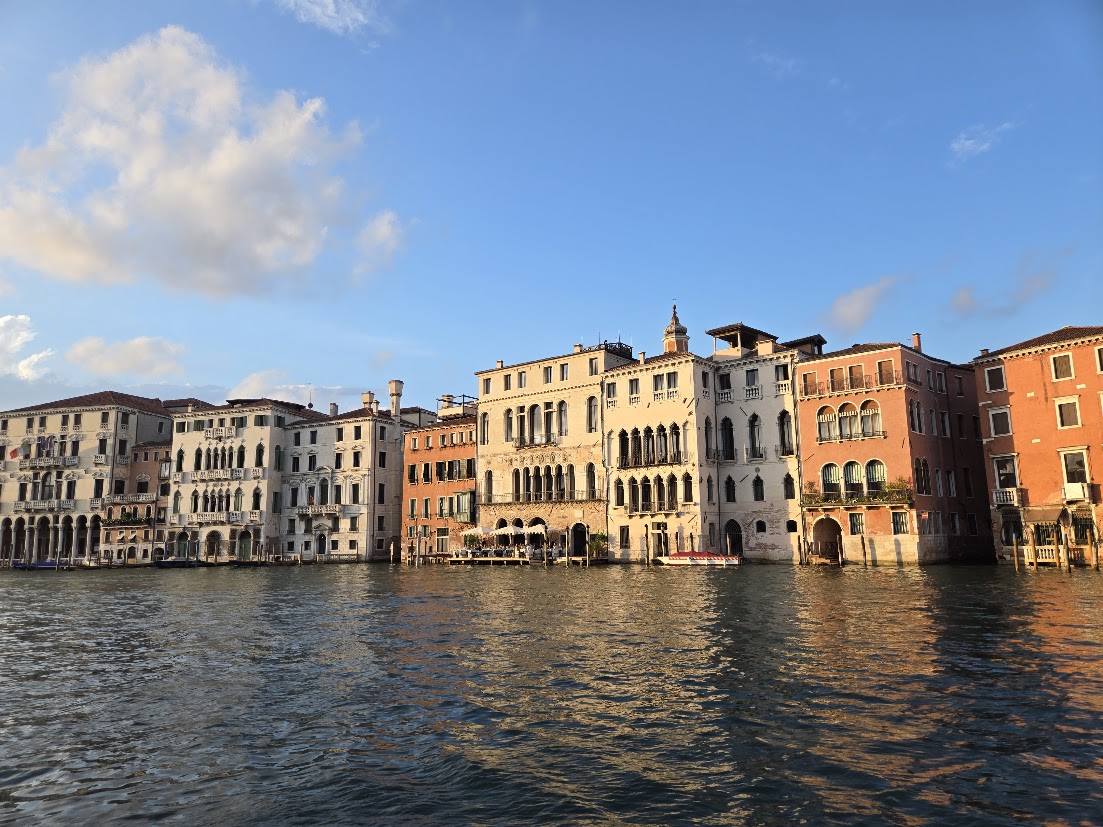
The term fragilient perfectly embodies Venice today, which along with its historic and iconic beauty is both incredibly fragile and necessarily adaptive and resilient in the face of the escalating threats from climate change.
The organizers set a high bar for VCW26, describing it as “a collective call to action, a living ecosystem of dialogue and action and a gathering of scientists, institutions, citizens, innovators, activists, and artists united by one shared mission: to imagine and build a future that is not only sustainable, but regenerative, equitable, and profoundly human.”
They added that the defining challenge of this generation is “to reconnect with the planet that sustains us to rebuild our relationship with nature, with water, and with one another.”
Appropriately, they cited the unique structure and location of Venice, noting that it is a city that for centuries has lived in both harmony and tension with water, and that duality drives the purpose of Venice Climate Week – transforming fragility into collective strength and vulnerability into a driver of innovation.
And that transformational focus is what brought me to Venice Climate Week, both this year and last.
With the theme of Planet Aqua, Planet Peace, the core focus of Venice Climate Week 2026 revolved around water, as it should, because Venice is an ancient city built on water. As such, like the Small Island Developing States (SIDS), Venice is ground zero in the climate crisis as sea-level rise fueled by emissions-driven global warming (coupled with ocean acidification and saltwater intrusion) threatens its very existence.
But a related critical point of focus involved food and the global food system, because, as VCW26 co-curator Sara Roversi noted, we still must find a way to feed an expected population of ten billion citizens by 2050. And we must do so in a sustainable, regenerative and equitable manner, reversing the many externalities (particularly emissions) related to the production, storage, distribution, consumption, and wastage of food that are contributing to the world’s current calamitous march beyond planetary boundaries.
On that score, I joined several multi-disciplinary experts (Hunter Lovins of Natural Capitalism Solutions, Merijn Dols of NOW Partners Foundation, David Laborde of UNFAO, and Paul Polman, former Unilever CEO and co-founder of IMAGINE) in a session at IUAV focused on the connection between food and climate and UNFAO’s Global Roadmap for Climate-Resilient Food Systems.
I was pleased to once again see the coverage of the Roadmap, with its appropriate focus on food systems transformation as reflected by its subtitle: How Agrifood Systems Transformation Through Accelerated Climate Actions Will Help Achieving Food Security and Nutrition, Today and Tomorrow.
I previously covered the Roadmap in this 2023 post from COP28 in Dubai, noting that:
The Roadmap builds on the work of the prior Food System Summits and includes a three-year plan for transforming agrifood systems to simultaneously meet food security, nutrition, and climate change needs. The anchoring principle for the roadmap is a Just Transition – inclusive decarbonization that leaves no one behind – with 120 targeted action points over ten domains: livestock, fisheries and aquaculture, crops, enabling healthy diets for all, forest and wetlands, soil and water, food loss and waste, clean energy, inclusive policies, and data.
The roadmap provides a framework for countries to establish action plans for food system transformation, and it was the perfect backdrop for our VCW26 session which linked critical themes of food, water, energy, climate, and humanity under the overarching theme of taking urgent action to not only save Venice, but to save the planet.
David Laborde kicked off our discussion, noting that the world is currently mired in substantial denial, division, distraction, and doomism which collectively hinders progress on sustainable development, reminding us that we can’t solve what we choose not to see. He pointed to social, environmental, and economic pressures, adding that we now have more citizens facing hunger than in 2023, we have breached seven of nine planetary boundaries, and the hidden costs of developed world economies are mainly being borne by the developing world.
And he went on to cover what we must do to drive positive change, starting with a focus on increased food productivity, equity, coordination, and investment. He reviewed the core elements of the Roadmap, including the ten domains connecting all sectors (as noted above), examples of the 120 Action points, the 20 global milestones, and the three tracks of development (Policy and Governance, Science and Evidence, and Costing and Modelling).
Central to this discussion was the need for urgency, collaboration and country level action – we don’t have time to wait. As Paul Polman stated, “we are at one minute to 12.”
Hunter Lovins followed with a strong call for the scaling of regenerative agricultural solutions.
Paul Polman also cited the need to rapidly transition to a regenerative food system, noting that the world is at just 6-10% regenerative farming today, but with appropriate subsidies and technology implementation we can quickly increase that percentage. He stressed the importance of thinking holistically and seeking system change breakthroughs, along with moving from a focus on calories to nutrition and rethinking food waste as a value opportunity.
I made the food waste (and larger food system) connection to climate change in this session, noting the scale of global food loss and waste (up to 2 billion tonnes annually), the essential need to properly value our food resources and change the developed world culture which normalizes excessive waste, the tactical risk management paradigm in foodservice that leads to waste versus waste reduction, and the need for increased awareness of the impact of global food loss and waste, along with the importance of increased education, collaboration, innovation, and especially leadership to reduce it in accordance with Target 12.3 of the Sustainable Development Goals (which calls for halving food waste by 2030 and reducing food losses along supply chains).
For Venice, the emissions impact of the food system, and food waste, is very real.
The food system accounts for just over a third of global greenhouse gas emissions, while food loss and waste alone accounts for about 8-10%. Fifteen years ago, the UNFAO provided the striking equivalency that if we were to rank global food wastage as a country, it would be the third largest emitter of greenhouse gases behind the U.S. and China. And more recently, the COP28 Action Toolkit cited a 2020 paper in Science noting that even if all non-food greenhouse gas emissions were immediately stopped, emissions from food systems would still result in exceeding the 1.5°C limit of the Paris Agreement between 2051 and 2063.
Beyond the issues of sea level rise and ocean acidification from these emissions, excessive food loss and waste leads to wasted water, land degradation, deforestation, biodiversity loss, and plastic pollution, not to mention the missed opportunity to provide needed nutrition for hungry citizens.
So food loss and waste is truly a nexus issue, and quickly accelerating progress toward the global goal of halving food waste is of great importance to Venice and all nations of the world.
And that nexus aspect also provides great opportunity – reducing food loss and waste at scale simultaneously drives progress toward multiple Sustainable Development Goals. Further, by preventing the occurrence of food waste we create maximum impact, avoiding 80% of the GHG load related to that waste along with all of the resource-related externalities from farm to fork to landfill.
In my talk I referenced a comment made by Paul Polman on the need to accelerate the pace of food systems transformation at the 2021 UN Food Systems Pre-Summit in which he noted that “With our own existence being put at risk, with enormously attractive economics, it’s just mind-boggling to me that we’re not moving faster.”
He went on to add: “It is impossible to achieve the Paris Agreement on climate, or the Sustainable Development Goals, unless we drastically change the food system. And the most interesting thing is that of all the options we’ve looked at, in any part of the Sustainable Development Goals, this probably has the highest return – from an ecological, from a social, as well as from a financial perspective. Anybody that looks into this can see the enormous opportunities, and that’s also true for the private sector.”
I completely agree.
Food waste reduction is at the heart of the needed food system transformation efforts to enable the world to feed all citizens within planetary boundaries, and It provides a massive unlock for social, environmental, and financial gains.
So why are we moving too slowly on it?
As I noted in a session at ISIA Roma Design with food design leader Sonia Massari just prior to VCW26, food waste in the U.S. and other developed countries at core is a problem of improper valuation stemming from a culture of abundance. Consumers have a “big” mindset, equating value with portion size and quantity. They also expect perfection in terms of the size, shape, and appearance of fruits and vegetables, along with excessive variety on a 24×7 basis. Food is also relatively inexpensive, and it is easy to discard and replace.
Combining these factors with a big purchasing mindset and confusion over date labels, we have quickly moved away from a culture of responsibility toward food from the War era to a culture that has normalized food wasting behavior while de-normalizing food waste reduction behavior.
Food waste is also a problem of visibility; efficient disposal systems whisk food away to distant landfills (where it decomposes and generates the super-pollutant methane gas) so that consumers don’t “see” it.
And like climate change, food waste is a problem of horizon. Even many informed consumers fail to connect the impact of their food wasting actions today with the future impact of that waste on the planet in the future.
We need to flip this.
As I walked around Venice during VCW26 and marveled at its beauty, its underlying innovation, and its fragility, I returned to the issue of valuation.
Venice is unquestionably one of the world’s most magnificent cities, with millions of visitors annually. And it is showing the impacts of emissions-driven warming today, with worse to come in the future.
Given that so much of the world places such a high value on Venice, shouldn’t it be a marker for changing our behaviors and systems to preserve it? After all, an uninhabitable Venice is unimaginable.
There is a parallel to our food system. Food is essential for our existence, yet we tolerate all of the externalities of the linear and extractive system that provides that lifeline, including loss and waste of 30 to 50% of annual production across the globe despite the substantial emissions impact and the obvious disconnect with hunger, as well as the negative impacts on water, soils, forests, biodiversity, and oceans.
Given these factors, shouldn’t we lead the effort to properly value our food resources, seeking to minimize waste while moving to a sustainable, regenerative, and equitable food system that benefits all while reducing pressure on critical planetary boundaries?
Last, I come back to fragilience.
The fragility of Venice requires adaptation and innovation for survival. And it requires urgent mitigation of emissions, particularly through food system transformation, to achieve long term resilience and guarantee the survival of the global treasure that is Venice.
It is the perfect metaphor for the planet, as our current actions and systems lead us to continue to transgress critical planetary boundaries.
Strolling through Venice leads one to imagine the audacity and innovation needed to create such a beautiful city centuries ago.
But it is easy to get lost in the overwhelming beauty and ignore the warnings of the ongoing threats to the city.
It is too easy for us to think that Venice will always be there.
Perhaps the primer for the needed action is: What if it isn’t?
Are we willing to change our valuations, and our behaviors and systems, to protect what we truly value?
The stakes could not be higher.
We must see the parallel between saving Venice and saving the planet.
And we must find the collective will and leadership to meet the action call of Venice Climate Week 26: To imagine a future that is not only sustainable, but regenerative, equitable, and profoundly human.

