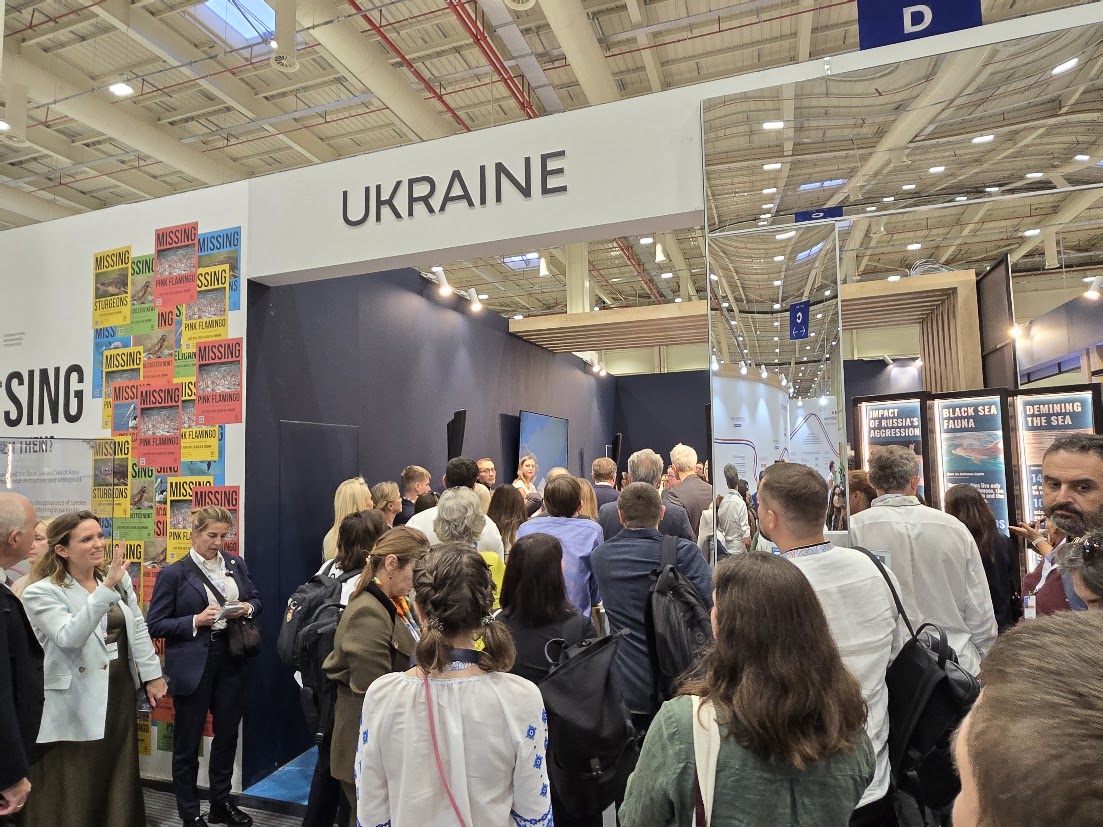
I attended the early days of COP31 in Antalya with specific intent on exploring and contributing to the global conversation on food security, food waste, and food system transformation.
Resilience, adaptation, innovation, and circularity are essential elements of that transformation effort to enable the world to meet the challenge of feeding 10 billion citizens by 2050 in a sustainable, regenerative, and equitable manner.
At each COP, I not only seek to learn through engagement with individuals and events, but I also seek examples of inspiration for action on advancing progress across the Sustainable Development Goals platform.
And while I typically write about key takeaways regarding food system transformation efforts upon return, this year is different.
This year my inspiration for transformational change was found in the Ukraine Pavilion, where I discovered new meaning to the themes of resilience and circularity to advance sustainability initiatives in the wake of Ukraine’s wartime crisis management efforts.
Crisis management comparison
First, let me quickly lay the groundwork for a comparison between crisis management efforts for sustainability – one which made my experience in the Ukraine Pavilion at COP31 so powerful.
In the midst of the Covid era, when businesses were largely shut down in the U.S., I was asked to participate in a roundtable series of discussions with leaders of several food organizations. The idea was to plan for how to emerge from the Covid disruption with maximum impact; specifically, how to emerge with resilience.
Over many sessions, I encouraged these leaders to use the crisis to rethink their organization’s values and operations, embracing responsibility and seeking opportunities for implementing sustainability initiatives – such as food waste reduction or sustainable packaging – in order to save money, reduce environmental impact, and engage employees and clients on the importance of integrating sustainability into operations.
But over the course of many sessions, it was clear to me that these leaders were almost entirely focused on the financial bottom line. There was recognition of the importance of sustainability for long term survival, but little appetite for implementing sustainability initiatives in the immediate term. Sustainability initiatives were viewed as an added cost and unnecessary distraction at that critical time. The mindset was clear: let’s get out of this crisis, re-establish operations and earnings now, and we will address sustainability initiatives later.
That is a mindset that organizations (especially food organizations) could not afford then, and in the wake of all the highly visible signals of the externalities of climate change and insufficient progress on the SDG agenda, it is one they certainly cannot afford now.
Fast forward to today and the parallel to Ukraine.
Ukrainians are in the midst of their own crisis of enormous magnitude, a brutal war launched upon their country by Russia.
Yet despite being forced into five years of fighting while experiencing countless human and environmental atrocities and the daily bombing of its cities, Ukraine has demonstrated unwavering resilience – not just from a military standpoint, but regarding the environment as well.
And unlike the business leaders mentioned above, Ukraine’s leaders have refused to use the war as an excuse for inaction on planning for and investing in resilience and circularity initiatives. Impressively, they see the crisis as an opportunity to advance sustainability initiatives, not as a reason to delay.
It was clear to me that this mindset has been embraced by the Ukrainian people as well.
There was a palpable sense of calm, steely resolve among the Pavilion’s team members, a united spirit to move forward on sustainability commitments – and to continually update those commitments – as an integral response to the war launched upon their country.
They embody the term resilience, and they are intent on making progress on sustainability initiatives – both for their benefit and for the global community.
Lessons on resilience, circularity, and sustainability
I attended two sustainability-focused sessions at the Ukraine Pavilion as well as the opening ceremony; each provided many powerful learnings.
At the first session, Ukraine’s Climate Strategy until 2036: Building Resilience Through Recovery, EU Integration, and Risk-Informed Action, Ukraine presented its new draft Climate Adaptation Strategy to 2036, noting the increasing risks that climate change brings to its economy, ecosystems, infrastructure, and communities – all of which are magnified by Russia’s 2022 invasion and the ongoing war.
The new strategy seeks to “establish strategic priorities for adaptation and support the integration of climate considerations in sectoral policies, recovery planning and decision-making at national and subnational levels.”
Discussion included background on how the strategy was built, key principles guiding implementation (including climate-resilient reconstruction, nature-based solutions, fairness and inclusion, and more), and priorities and implementation needs for several sectors (including agriculture, wetlands and forests, hydrometeorological early warning systems, and climate-resilient recovery and reconstruction).
Highly notable was an early statement that adaptation is part of Ukraine’s resilience today, and not a future agenda item.
This strategy update follows the release of Ukraine’s Strategy for Environmental Safety and Climate Change Adaptation until 2030 in October of 2021, the approval of a November 2026 bill updating that strategy, the submission of its Climate Change Adaptation Communication to the UNFCCC in May of 2024, and the publication of its Long-Term Low-Emission Development Strategy of Ukraine Until 2050.
So it is very clear that despite countless crises incurred as a result of the ongoing war launched on the country in February 2022, Ukraine has continued to focus on its contribution to addressing climate change and advancing sustainable development.
Another example involves the September 2026 adoption of Ukraine’s Circular Economy Development Strategy Until 2025 which includes seven priority sectors (food production and distribution, agriculture, construction, textile manufacturing, electrical and electronic equipment, the extractive industry, and metallurgy), five strategic objectives, and key targets for 2035. Examples of the targets include 1) at least 30% of public construction tenders will include sustainability criteria for secondary and recycled materials, and 2) 20% of edible food from retail outlets that would otherwise go to waste will be directed to food banks. The strategy is accompanied by an operational plan for 2026 to 2028 listing over 60 measures with operational deadlines.
The above strategy formed the basis for the second session that I attended focused on zero waste and circularity, Zero Waste Without Borders: Ukraine’s Contribution to a Sustainable Future, which centered on how Ukraine’s policy progress, experiences, and partnerships can contribute to a circular, resilient, and sustainable future for Ukraine and all nations.
Here, citing the destruction of buildings and infrastructure from the war, Oleg Bondarenko of Ukraine’s Committee on Environmental Policy and Nature Management opened with a compelling point, noting that zero waste is “not an abstract concept” for Ukraine but has instead “become a matter of national resilience, security, and survival amidst a full-scale war.”
Denys Bashlyk, Deputy Minister of Agrarian Policy and Food of Ukraine, referenced the constant wartime disruptions (including lack of energy, fuel, seeds, and fertilizer coupled with general uncertainty) that create challenges for agribusiness, but added that Ukraine is ready to move forward with climate-oriented technologies and circular initiatives today and in the future. He added that he is already seeing evidence that companies that have invested in recent circular initiatives are realizing additional profits.
Uliana Boiarchuk, Advocacy Manager for Zero Waste Alliance Ukraine, discussed her role in uniting NGOs around the idea that zero waste needs to be a norm in Ukraine, and that zero waste principles must be incorporated into national, municipal, and international policies.
She pointed to the world’s breaching of seven of the nine critical planetary boundaries, and the importance of rethinking our use of resources under the zero waste framework (as Ukraine is doing) to help the world stay within those boundaries.
Boiarchuk gave two compelling examples of Ukrainian efforts in this area. The first involves the Circular Construction and Repair Yard (CC Yard) by Zero Waste Kharkiv. Here she matter-of-factly stated that “unfortunately during a time of war we have a lot of post-war debris.” At the CC Yard, debris from the damaged buildings is stored and sorted and then distributed to individuals in need of such materials to rebuild damaged homes.
Another example of reuse and repair involves textile recycling by Emmaus-Oselya in Lviv, a social organization which collects and resells numerous items (including used clothing and furniture) and uses the revenue to support shelter operations.
These examples are incredibly powerful, supporting Ukraine’s theme that “resilience is our defense.” We tend to think of circular initiatives like recycling or food donation in abstract terms with little meaningful connection; Ukraine discusses them as crucial to the very survival of their country.
Last, I attended the opening ceremony of the Pavilion, Ukraine: Resilience Shaping the Future, which effectively built upon the prior sessions and reiterated Ukraine’s commitment to responsible actions for sustainable development with this key message: “Ukraine is not only protecting its future, but also contributing to the formation of a safer, more sustainable and climate-neutral world.”
Oleksandr Kravchenko, Ukraine’s Minister of Economy and Environment, cemented that connection, noting that “Here in Antalya, Ukraine’s practical experience in crisis management, green innovation, and energy decentralization is making an important contribution to global climate security.”
Significantly, he added that “Despite all the challenges, Ukraine remains firmly committed to meeting its international climate obligations.”
Inspiration for Sustainable Action: No excuses
When I engage at COP events, conferences, and other projects (like the roundtable mentioned earlier), I am always focused on the imperative of accelerating progress on the SDGs by developing resilient food systems or reducing the drivers of climate change while highlighting the value of integrating sustainability into business operations.
We have the solutions and tools for such change, and we know what to do.
At core, the lack of sufficient progress on climate change and the SDGs to date comes down to a lack of commitment, will, and leadership for action.
Indeed, that is why COP31 is being referred to as “the implementation COP.”
It is far too easy for organizational leaders to find excuses to move too slowly on sustainability initiatives, to avoid making bold commitments, taking action, and reporting transparently on the results – particularly in times of crisis. Too often there is a perception that there is less risk in maintaining the status quo and doing sustainability later.
There’s not.
Company leaders and policymakers in other countries, especially those with the luxury of not experiencing the continuous brutal impact of war, would do well to look to Ukraine for lessons on committing to action on resilience, circularity, and sustainability initiatives.
Ukraine is not relenting on its resilience and circularity work, nor the evolution of its sustainability plans and commitments – even in the midst of war – and remains committed to its international climate commitments.
I found Ukraine’s actions, and the resolute, persevering attitude of all the Ukrainians on site at COP31 to be truly inspiring.
One of the speakers with whom I spoke summed up the collective mindset of resilience perfectly, saying “it’s been five years, we can’t just hide in a bunker, we have to move forward.” Another speaker referenced the loss of critical weather observation stations in the occupied territories, adding “yet we refuse to stand still.” A third added “Despite the war, despite the blackouts, despite the missile and drone attacks, we still work, we still improve and enhance our workflow.”
Last, Oleg Bondarenko reiterated Ukraine’s commitment to its sustainability initiatives, stating “Despite daily security challenges, damages to infrastructure, and limited resources, Ukraine is not halting its movement towards a circular economy. We deliberately refuse to use wartime as an excuse and continue the systematic reform of our waste management sector.”
The no-excuse mindset of the Ukrainians toward sustainability commitments is incredibly inspiring, and leaves me with the obvious question:
What if business leaders and policymakers around the world all felt this way?
As every annual COP event shows, we are well behind schedule for bigger, faster, bolder action on climate change and other critical SDG targets.
And as Ukraine very credibly shows, there is no excuse for inaction.

