On the day after the glacier collapse that buried the Swiss town of Blatten last year, I was on a flight to Europe and speaking with a German student who was studying in the U.S. at the time. When I brought up the destruction in Blatten, in a country bordering his home country of Germany, I was surprised to hear that he was not yet aware of it. After I filled him in, he acknowledged, “yes, I guess I really should know about that.”
I could not help but recall that conversation this month as news of the recent glacier collapse that has devastated Nepal and Tibet emerged.
In the wake of so many other recent climate-related disasters – the Canadian wildfires, the European heat waves and associated wildfires, and the drought impacting river levels throughout Europe – I was struck not only by the enormous impact (financial, social, and environmental) of these disasters but by their enormous visibility as well.
We are all seeing and experiencing the impacts of emissions-driven warming in the form of extreme heat, massive fires, smoke, drought, floods, and melting ice.
There is no avoiding them. There is no “not seeing” them.
The challenge, as I noted in my July post, is not to normalize them (resulting in inaction), but to go deeper and truly “see” these events as critical signals of human-induced warming that require unprecedented collaborative action between nations.
Further, it is essential that we view these events as signals of the manner in which we are overshooting planetary boundaries. Fortunately, the Global Footprint Network (GFN) provides the perfect framework in the form of Earth Overshoot Day.
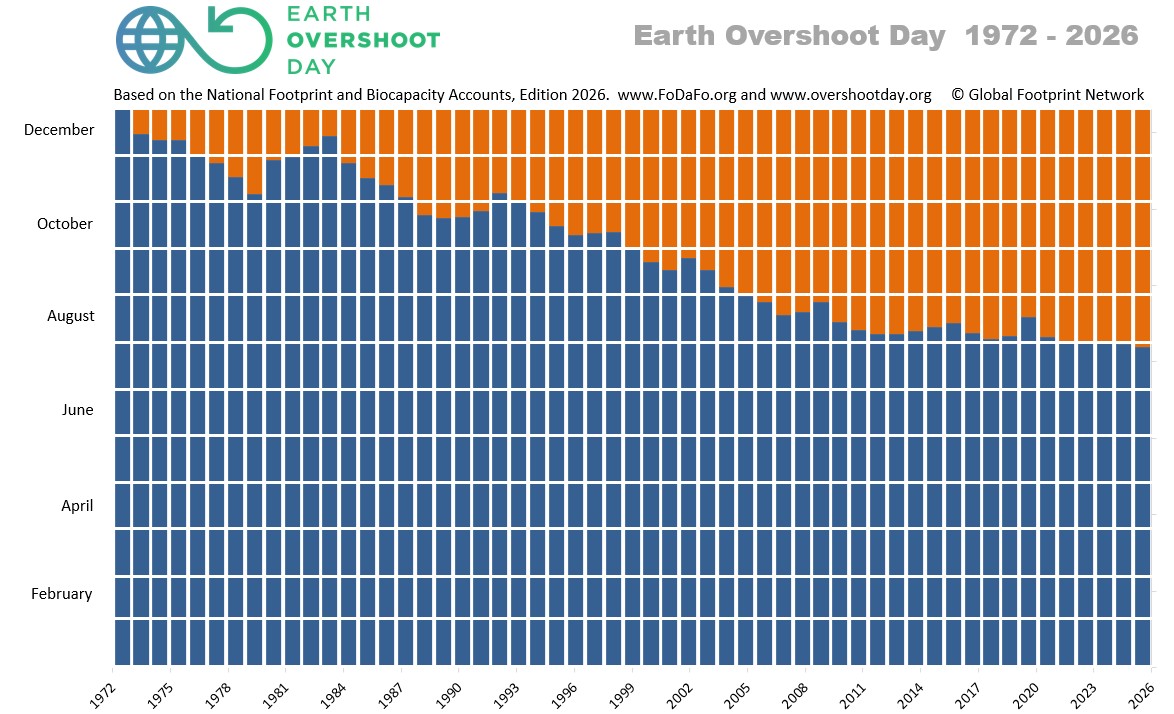
A few weeks ago, the GFN reported that Earth Overshoot Day for 2026 fell on July 30th. This marks the date on the calendar in which humanity’s demand for ecological resources and services exceeds what the Earth can regenerate in that year. Beyond that date, we are living in a condition of overshoot.
Similar to living beyond one’s financial means and going into financial debt, Earth Overshoot Day reflects our collective ecological debt – and the symptoms (i.e. costs) are increasingly visible in terms of rising global temperature, ocean warming, biodiversity loss, and the recent disasters (heat, fires, drought, glacial collapse) noted above.
Earth Overshoot Day is a relatively simple yet incredibly powerful concept (see details of the calculation methodology here) and one that in my view does not yet receive sufficient attention.
That must change.
Of great concern is the trend in Earth Overshoot Day. It is moving in the wrong direction – indicating that we are depleting the Earth’s biocapacity at an increasing rate. Just ten years ago, when the Sustainable Development Goals (SDGs) were released, Earth Overshoot Day fell on August 12th. In the year 2000, it fell on September 23rd. In 1990, it fell on October 23rd.
As the GFN notes, this ecological debt stems from the overuse of Earth’s resources, and this overuse “leads to the liquidation of ecological resources and the accumulation of waste, most prominently carbon dioxide in the atmosphere.”
Just as we can’t continue to overspend beyond our personal means, we can’t continue to exceed Nature’s annual capacity. There is a limit.
And there are major equity issues involved. The GFN also tracks Country Overshoot Days, which is defined as the date on which Earth Overshoot Day would occur if all of humanity lived like people in that country.
Not surprisingly, Country Overshoot Day for many highly developed countries occurs very early in the calendar, and much later for less developed countries.
For example, Country Overshoot Day falls on March 14th for the United States, April 2nd for Austria, and April 24th for France. Conversely, it falls on August 12th for Peru, August 14th for Brazil, and October 1st for Colombia.
For highly developed countries, the early Country Overshoot Day figure should bring a sense of responsibility, for they are creating externalities that are borne by less developed countries that generate far less ecological impact.
Signals of Overshoot
Earlier this month, the World Meteorological Organization (WMO) noted that July 2026 was the warmest July on record (tied with July 2024), adding that (per NOAA) July 2026 and July 2024 are more likely than not the warmest months on record for the globe since 1850.”
The Copernicus Climate Change Service reported that sea surface temperature across the extra-polar oceans was the highest ever recorded in July.
The World Resources Institute recently highlighted that the past 11 years (2015-2025) are the hottest on record, and that fires now burn twice as much forest compared to 20 years ago.
And The Wall Street Journal revealed how drought conditions throughout Europe are drying up rivers and disrupting power generation, commerce, and agriculture.
These are all signals of emissions-driven overshoot that can’t be ignored; the immediate impacts and longer-term threats are simply too great.
Renewed Warnings and Action Calls
In a recent post, UN Climate Change Executive Secretary Simon Stiell cited such signals — recent heatwaves, floods, and violent storms — and noted that “the climate alarm is blaring, from every direction.”
He added that “climate-driven disasters are reaching nightmare proportions, as the costs of humanity’s addiction to burning coal, oil and gas keep spiraling upwards” and that “these spiraling disasters are now the lived reality for billions in a world getting rapidly hotter, as humanity moves too slowly from fossil fuels to clean energy and to protect forests.”
Stiell appropriately called for the world to “leave coal, oil and gas behind faster, scale up renewables, and protect people where the impacts are already hitting hardest.”
In addition, in response to the heat and wildfires scorching Europe, the government of the UK issued a joint statement on wildfires and action on climate change with the government of Spain which affirmed that climate change was “now a national security emergency facing Europe and threatening our way of life.”
In it, the two countries agreed that tackling climate change was “an urgent policy priority for all countries” and that climate action was essential to protect current and future generations.
Further, they agreed on the importance of prioritizing action to combat climate change in their foreign policy and on the need to co-lead the green energy transition, while also recognizing that “climate change is a global challenge that must be addressed through effective multilateralism.”
In addition, they reaffirmed their support for the UNFCCC and expressed “the need to work towards the fulfilment of the international commitments contained in the Paris Agreement, underlining in particular the urgency of increasing global efforts to limit the increase in temperature to 1.5°C above pre-industrial levels.”
They also agreed on the importance of “adopting the necessary measures to drastically reduce our dependence on fossil fuels” and on supporting countries of the Global South on their transition to clean energy.
Encouragingly, the UK government signed a similar statement with the government of France in which both countries recognized that “the increasing impacts of climate change know no borders” and reaffirmed their support for the UNFCCC and the Paris Agreement goals. They also called on all parties and major emitters to publish their NDCs aligned with the 1.5°C goal and contribute to the transition away from fossil fuels as agreed at COP28 in Dubai.
I applaud the governments of the UK, Spain, and France for these agreements, and I look forward to seeing how they will be carried forward to drive greater collaborative action at COP31 in November, because the urgency level has never been clearer.
The Choice: Cooperate or Perish
We are all seeing and experiencing the impacts of overshoot in the form of extreme heat, drought, fires, smoke, floods, glacier collapse, and more.
We must go beyond merely recognizing these signals (and their drivers) and take responsibility for them, especially the citizens of the most developed and affluent countries.
As I reflected on the many recent signals of overshoot this month, including the glacier collapse in Nepal, I was reminded of UN Secretary General Guterres’ opening remarks at COP27 in Egypt four years ago — comments that are even more relevant today.
Significantly. that event coincided with the global population hitting the 8 billion mark, and Guterres began by asking the question: How will we act when baby 8 billion is old enough to ask: What did you do for our world, and for our planet, when you had the chance?
Stressing the need for urgent action, he noted that climate change is “the central challenge of our time” and that “it is unacceptable, outrageous, and self-defeating to put it on the back burner” in the face of conflicts.
On the theme of responsibility, he noted that “human activity is the cause of the climate problem, so human action must be the solution.”
He also called for G20 countries to accelerate their net zero transition, and for a climate solidarity pact with developed countries assisting emerging economies with their renewables transition.
He reminded all of us that “the deadly impacts of climate change are here and now” and that “we must acknowledge a harsh truth – there is no adapting to a growing number of catastrophic events causing enormous suffering around the world.”
That statement is particularly relevant today in the face of recent glacier collapses, extreme wildfires, and severe drought and storms.
Guterres famously warned that “Humanity has a choice: Cooperate or perish. It is either a climate solidarity pact or a collective suicide pact.”
Just four years later, that warning looms large as the signals of overshoot become increasingly visible, destructive, and frequent.
Similar to Guterres’ warning, the Global Footprint Network reminds us that overshoot will end, the only question is how it ends, by design or disaster.
Further, the GFN notes that “the biggest risk is not overshoot itself but not responding to it.”
Baby eight billion deserves the action path of responsible cooperation to end overshoot by design – the climate solidarity pact.

